Showing posts with label One Sheet. Show all posts

Tuesday, 18 December 2018

An Axe to Grind: Christmas One Sheet

Here comes a chopper to chop off your head!
Chip, chop, chip, chop,
the last goblin is dead!

A couple of years ago, a goblin crew hijacked a flying sleigh belonging to a mysterious red-robed sorcerer, and unceremoniously tossed him overboard. The jolly fellow was dashed upon the mountains below, leaving nothing but a stain to mark his passing.

A few days ago, a dyslexic human witch accidentally brought the red-robed sorcerer back from the afterlife while attempting to summon the devil. After breaking free from the ritual and killing the witch, the sorcerer headed west into the goblin lands, seeking revenge!

Every year, I release a new Christmas-themed One Sheet for Saga of the Goblin Horde – Sanguine Solstice in 2015, Sleigh Heist in 2016 and Season's Beatings in 2017. Here is the adventure for 2018:

Get it here: An Axe to Grind

This One Sheet is a direct sequel to Sleigh Heist and Season's Beatings, although it can also be run as a standalone adventure. The Configurable Map has also been updated.

Monday, 25 June 2018

Jumping the Bearsharktopus: One Sheet

A Redfang scout recently discovered a huge mound of bear excrement deep within Shadowglade Forest. For reasons that are probably best not discussed, the scout decided to thoroughly examine the dung, and found it contained the bones of several sea goblins, as well as a fishing net and even a small anchor! Has the legendary Bearsharktopus finally woken up again, after decades of hibernation? And more importantly, what does the great beast taste like? Chief Bignose wants to know!

Last week I released the Saga of the Goblin Horde Countdown Deck, and I thought it might be nice to write up some examples of how to use the saga symbols on the cards. But I always find it difficult to write hypothetical "actual play" scenarios, so I decided to turn them into a proper One Sheet adventure instead.


If you want to follow the progress of Saga of the Goblin Horde, please don’t forget to sign up to the official Facebook group!

Saturday, 12 May 2018

Back to the Roots: One Sheet

Last month GGstudio invited me to Modena Play, for my first ever gaming convention, and I was asked to run a couple of Saga of the Goblin Horde games!

I wanted to run a new adventure, but didn’t have time to create something from scratch, so I combined my favorite elements from three different adventures—the ornithopter run scene from Can of Wyrms, the war horseradishes from Root of the Problem, and the ambush cards from Dungeon Squat (the first Plot Point Episode in the setting book).

I was able to run the adventure for Giuseppe Rotondo, James Horton and Riccardo Giannico at the convention, and it was well received, so with some effort (and a few adjustments) I’ve just about managed to squeeze it into a new One Sheet!

Get it here: Back to the Roots

As always, if you’re interested in following the progress of Saga of the Goblin Horde, don’t forget to sign up to the official Facebook group!

From left to right: Giuseppe, Riccardo, myself, and James.

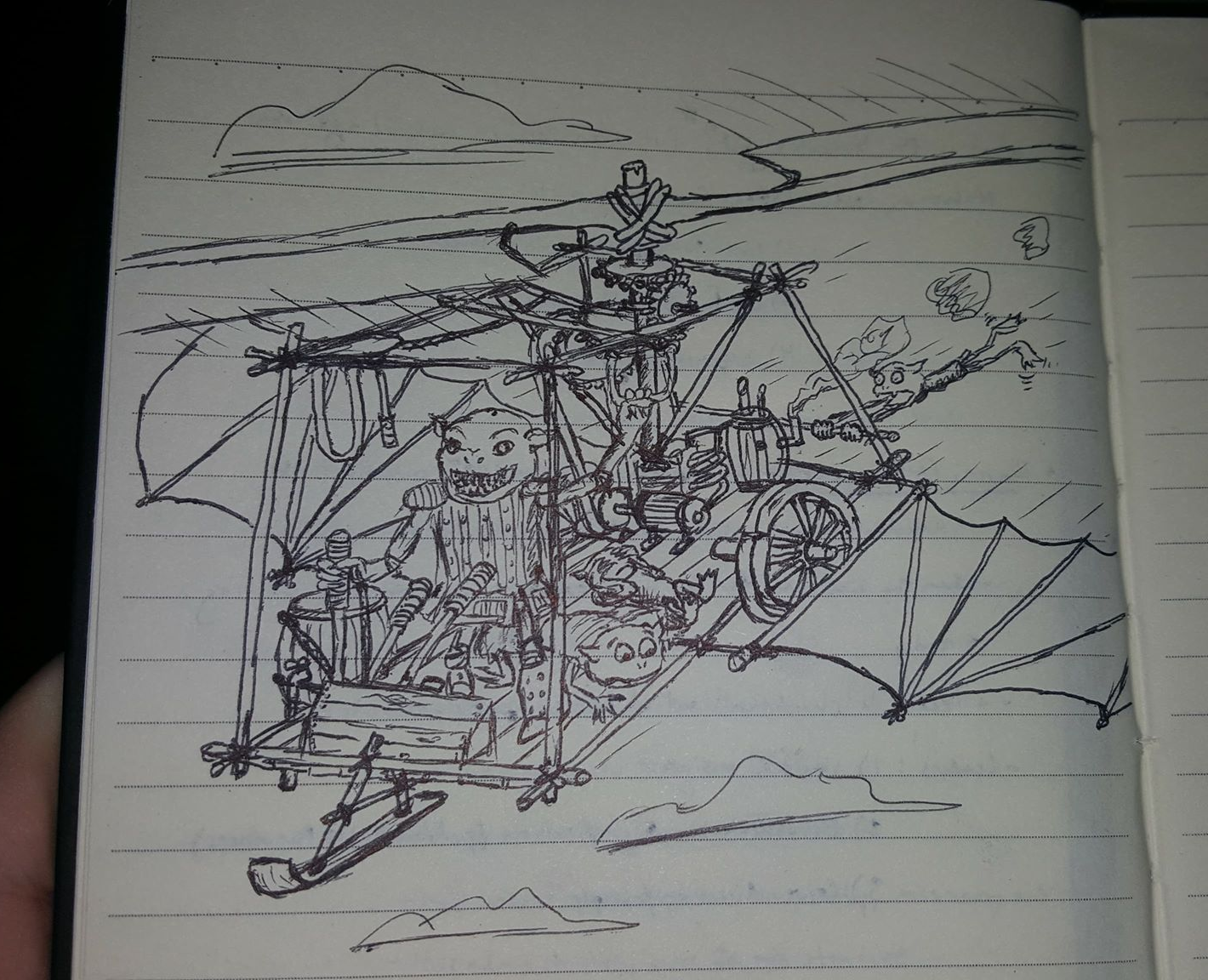
James even drew a doodle of the adventure!

Sunday, 26 February 2017

Hot Water: One Sheet

Last month, Frank Turfler of the Middle Kingdoms Adventure & Trading Company released a free map along with a plot hook about goblins, and he invited other people to add to the narrative and send in their own adventure ideas. How could I resist such an invitation?


If you're not yet familiar with Saga of the Goblin Horde, you can download the player's guide, 15 archetypes and 7 One Sheet adventures from here.

You can also listen to my interview on the Wild Die Podcast here, where I talk more about the setting.

And if you're on Facebook, join the Saga of the Goblin Horde group here.

Monday, 12 December 2016

Sleigh Heist: Christmas One Sheet

Swooping through the night,
Our rockets chase the sleigh,
Through the clouds we fight,
Laughing all the way!

On the same night every year, a mysterious red-robed sorcerer flies his enchanted sleigh to a nearby human settlement, dropping various wrapped packages down the chimneys before making his escape. The goblins admire his courage and tenacity, but not his success rate; as far as they can tell, none of the houses have ever blown up, or even burned down. The sorcerer clearly has no experience with explosives, and so the infamous gremlin artificer Grinchie Charfoot has decided it’s time for the professionals to take over.

Here's another One Sheet for Saga of the Goblin Horde:


As always, you can download the goblin archetypes from here, and the older One Sheet adventures from here, here, here, here and here.

Thursday, 3 November 2016

Root of the Problem: One Sheet


One potato, two potato,
three potato, four!
Five potato, six potato,
seven potato, WAR!

A nobleman has become frustrated with all the goblins hunting his knights and eating their succulent steeds, so he has ordered his druid adviser to create a horse that tastes so bad not even a goblin will eat it.

This initially seemed an impossible task, but then the druid discovered the one thing goblins won’t eat...vegetables!

Here's another One Sheet for Saga of the Goblin Horde:


As always, you can download the goblin archetypes from here, and the older One Sheet adventures from here, here, here and here.

Sunday, 16 October 2016

Samhain Surprise: Halloween One Sheet

Trick or treat, trick or treat,
Give me someone good to eat!
Trick or treat, trick or treat,
Someone meaty, someone sweet!

Once a year, the young children in the human town of Yellowbrick dress themselves up as goblins, visiting homes to collect candy while playing a strange game they call “Trick or Treat”. The goblins think this is a grand idea, and have decided to use the opportunity to sneak into town, play some vicious pranks, and enjoy some delicious treats. And better still, they won't even need to wear any stupid disguises!

With two weeks to go until Halloween, I thought it was about time to release my next One Sheet for Saga of the Goblin Horde. You can get it from here:


For this One Sheet I also teamed up with Frank Turfler of Middle Kingdoms Adventure & Trading Company, who has created a set of free maps designed to go with the adventure. You can download the maps from here:


As always, you can download the goblin archetypes from here, and the older adventures from here, here and here.

Thursday, 23 June 2016

Designing a One Sheet: Step-by-Step Example

Last week I described the eight steps I follow when designing an adventure, so now I'd like to walk through the process and create a One Sheet from scratch, showing each of the stages my adventures go through as they take shape.

For this example I've decided to create a follow-up to my Gray Matter One Sheet, which was the pilot episode in my fictitious Prophecy of Drakonheim Plot Point Campaign.

This episode (which is arguably the second half of the pilot, and not standalone like most of my other One Sheets) is called Broken Crown, and I've chosen to make it fairly "crunchy", to better juxtapose it with the "fluffy" Gray Matter adventure.

As with Gray Matter, Broken Crown assumes you're familiar with the setting, but this time I also borrowed the sewer exploration mechanics from the Heroes of Drakonheim adventure. If you're curious about the Drakonheim setting, I talked about it in more detail here and here; Heroes of Drakonheim (along with the companion) are part of the Savage Drakonheim Kickstarter - at the time of posting, there's only 16 hours left on the Kickstarter, so don't dawdle if you're interested!

If you just want the finished adventure, you can get it here: Broken Crown

Broken Crown

This adventure is a follow up to Gray Matter. The Gray Man was captured or killed in the previous adventure, but now the interested parties wish to discover where he came from - this could be the location he was guarding, or the secret lab where he was created, depending on his established origin. Unfortunately they're not the only faction who have discovered the location, and the heroes will need to compete with some rival agents.

The location contains a number of relics from the past, including an ancient broken crown, which appears to have been cleaved by a sword blow. Later investigation could reveal that the crown was once Ezarion's phylactery, which was sundered by the Band of Four and then lost to the annals of time, however that is a tale for another adventure...

Step 1: Adventure Overview

This overview is copied from the Prophecy of Drakonheim Plot Point Summary:

The heroes are hired to investigate the origins of the Gray Man, and uncover his secrets, but they soon find themselves caught up in a deadly race against other organizations. Who are these mysterious rivals, and can the heroes beat them to the prize?

Step 2: Adventure Breakdown

I split the adventure concept into five sections, with a short sentence for each:

Gray Origin: Give an overview of the mission objective depending on the Gray Man's origin and fate.

Sewer Search: Use the sewer exploration rules described in the Heroes of Drakonheim adventure.

Cavern Combat: A combat encounter in the cave, this environment has some specific effects (slippery floor, etc).

Lost and Found: The heroes discover the hidden location and recover an ancient crown.

Race against Rivals: A Chase through the catacombs against rival agents, as the heroes attempt to escape.

Step 3: Section Scope

I flesh out each of the sections with notes and additional details:

Gray Origin: Give an overview of the mission objective depending on the Gray Man's origin and fate in the previous adventure. Probable locations are a secret lab (Gray Society experiment), tomb or cache (undead guardian), or hideout (disguised opportunist). The location is hidden in the catacombs and accessable from the sewer, and the heroes have only a rough idea of the location.

Sewer Search: The heroes have to explore the sewers to try and find the appropriate entrance into the the catacombs. This can use the sewer exploration rules from the Heroes of Drakonheim adventure, perhaps with a few adjustments. The task cannot fail, but if the players do particularly badly they will be at a disadvantage in the next scene, while if they do particularly well they will receive a corresponding advantage.

Pale Killers: The heroes aren't the only ones in the sewers, and as they enter the catacombs they come face to face with a group of undead assassins. The heroes may be at an advantage or disadvantage, depending on how well they performed in the previous scene. Do these killers work for the Gray Society? Baron Karlos Vasili? Are they connected to the Gray Man in some other way? There's no way to know, because they fight to the death! This battle should include some specific special effects, such as areas of slippery floor, falling stalactites, etc.

Lost and Found: The heroes continue into the catacombs and discover the hidden location. This should require some sort of roll, with failure indicating that they blunder into a trap. The scene description should factor in the different possible locations - lab, tomb, cache, or hideout. Among the treasures, most of which have no real value except to a historian, the heroes discover an ancient broken crown. This seems to have pride of place, has obviously been examined and studied carefully, and cannot be missed. Anyone casting Sense Arcana can feel it has a lingering necromantic taint, although its active power has long since fled.

Race against Rivals: As the heroes leave the catacombs, they encounter several other groups who were presumably hired by rival factions, and there are far too many of them to fight. This turns into a Chase through the sewers, with a specific challenge and complication for each of the 5 rounds.

Step 4: Section Write-Up

I add an introduction and expand the sections into a full adventure:

In the previous adventure, Gray Matter, the heroes were hired to capture the Gray Man. Now their employer wants to hire them for another job, this time to explore the Gray Man's lair, uncover his secrets, and liberate anything of value.

Gray Origin

The specifics of this mission will depend heavily on the outcome of the previous adventure. If the Gray Man was an escaped Gray Society experiment then the hidden location is probably an arcane laboratory, while if he was the guardian of an ancient tomb or cache, the heroes will need to seek out the place he was guarding. On the other hand, if the Gray Man was just a disguised fanatic or smuggler, then the location will probably be a secret hideout.

But regardless of the specifics, the general goal of the adventure remains the same: the heroes must travel through the sewers, enter the catacombs, and recover whatever they find in the hidden location.

If the heroes were able to capture the Gray Man alive in the previous adventure, he will have been questioned physically and magically, and the characters will be privvy to additional details about the route they have to take. This advantage is represented in astract terms; award each player a Benny at the beginning of the adventure. If the Gray Man was killed in the previous adventure, the heroes will only have a rough idea of the location based on vague divinations.

Sewer Search

The sewers of Drakonheim are a danger place, and few have the courage to enter of their own volition, but the heroes must take this route if they wish to find the entrance to the catacombs.

Resolve the search as a Dramatic Task using Tracking, with the standard -2 penalty, except that there is no limit to the number of rounds - the players just keep on searching until they reach five successes. If the heroes draw Clubs, use the Random Encounter for the sewers (detailed in Heroes of Drakonheim); if they fail the roll, they are surprised by the enemy, but they may still continue with the Dramatic Task after resolving the combat.

If none of the heroes have the Tracking skill, they may be able to recruit the aid of Gozzy the Quiet.

Pale Killers

The heroes aren't the only ones in the sewers, and as they finally reach the entrance to the catacombs, they come face to face with a group of undead assassins. If the players required more than five rounds to complete the Dramatic Task in the previous scene, the assassins have time to set an ambush, and heroes are surprised. On the other hand, if the players required fewer than five rounds, it is the assassins who are surprised. If the players required exactly five rounds, neither side has a surprise attack.

It is unclear if these cloaked killers work for a rival faction, perhaps the Gray Society or Baron Karlos Vasili, or whether they are connected to the Gray Man in some other way. While they fight intelligently, they do not speak, and they fight to the death. The Game Master should field 1-3 killers per player, depending on how tough the heroes are.

Whenever one or more characters draw Clubs for initiative, the character with the lowest rank card must roll 1d6 and consult the following table, applying the effects immediately. If more than one character acts on the same initiative card, the result is applied to one of them at random.

1. The character steps on a patch of slimy rock, and must make an Agility roll at -2. On a failure he falls Prone, and cannot stand up again this round.

2. The character stumbles over a stalagmite, and must make a Strength roll at -2 or drop whatever she is holding.

3. A stalactite breaks free from the ceiling directly above the characters head. The character can attempt to dodge with an Agility roll, on a success it hits him in the shoulder rather than the head, while on a raise he's able to avoid it completely. The stalactite inflicts 2d6 damage, with an additional +4 damage if it lands on the character's head.

4. Dirt showers down on the character, dislodged by the sounds of battle, and she must make a Smarts roll to close her eyes and hold her breath. On a failure she is Shaken and suffers a level of Bumps and Bruises Fatigue, while on a success she is only Shaken, and on a raise she suffers no drawbacks.

5. The character feels ghostly hands touching his flesh and hears faint voices whispering in his mind. He must make a Fear check at -2.

6. The character accidently inhales a mouthful of dust from the stale air, and has a coughing fit. She must make a Vigor roll at -2 or become Shaken.

Lost and Found

The passage out of the sewers leads deeper into the catacombs below Drakonheim, and after a short walk the heroes reach a locked and heavily reinforced door. The door seems to be a relatively new addition, no more than a few years old.

Characters can open the door with a successful Lockpicking roll at -2, but on a failure they trigger a magical trap; everyone within a Large Burst Template centered on the door must make a Spirit roll or suffer 3d6 damage (with an Enervation trapping), as the lifeforce is drained from their bodies. It is also possible to force or break the door open, although this takes time, and will automatically trigger the trap. Once the trap has been triggered, it does not reset.

Inside the room the heroes discover a stash of ancient items, treasures of a bygone era that have relatively little value in the modern day. Rusted weapons, decayed artwork, soured wine, and more. However there are also signs of recent habitation - a dusty bed, an ink-stained, and a book shelf lined with arcane texts. Someone lived here until recently. At one side of the desk lies a twisted metal crown studded with gems. The Game Master might allow the players to discover a few other interesting trinkets scattered around, perhaps calling for a Notice roll to see how well they search, but the crown is impossible to miss.

Race against Rivals

Shortly after leaving the catacombs, the heroes run into several other groups who were presumably hired by rival factions. If the players insist on fighting, they will be heavily outnumbered (8-10 foes per player if they insist on standing their ground), so the obvious choice is to flee. The escape through the sewers should be resolved as a standard 5-round Chase, except that the complication (which occurs on Clubs) varies each round, as follows:

Round 1: Thousands of bats hang from the ceiling, and are disturbed as the characters rush past. Complication: Make a Spirit roll or become Shaken.
Round 2: The stench in this area of the sewer is overpowering. Complication: Make a Vigor roll or suffer a level of Fatigue.
Round 3: This part of the sewer splits into a labyrinth of narrow corridors. Complication: Make a Smarts roll or become Shaken.
Round 4: Rubbish and refuse has piled up, and the characters have to fight their way through. Complication: Make a Strength roll or suffer a level of Fatigue.
Round 5: A narrow walkway keeps the characters dry, but several alligators swim through the nearby water. Complication: Make an Agility roll or suffer d10+d6 damage from an alligator bite.

The listed complications replace those in the Chase Complication Table, but the roll still incurs the standard penalty based on the rank of the card (i.e., -4 for a 2 of Clubs, -2 for 3-10 of Clubs, and no penalty for a Jack or better).

Some of the rivals turn on each other, but around half of them (4-5 per player) give chase, believing that the heroes have already looted the Gray Man's lair. Split the foes into a number of groups equal to the number of players, with each group representing a different faction. The enemies can make group rolls for their maneuvering trait rolls, but must attack individually. Although the heroes are greatly outnumbered, there isn't much room to maneuver; only two members of each group can attack each round.

Step 5: Trim and Polish

I'm not going to repeat the whole adventure (you can see the final text in the PDF below), but I did several sweeps through the document, changed the wording in several places, and added a couple of statblocks.

Step 6: Layout and Final Editing

I was able to reuse the Scribus template from Gray Matter, which saved some time, but it still took a while to do the layout and final editing, and I needed to choose some different artwork.

Step 7: Final Checks

I converted the hyphens to n-dashes where necessary, double-checked the layers, made sure all the fonts were embedded, and ran the assassin statblock through my analysis tool.

Step 8: Call a Friend

Normally I'd ask some friends to proofread the adventure, but I skipped this step as I was short on time (so no doubt I've missed something). However the One Sheet is generally quite presentable; it's surprising how much difference a clean layout and a little artwork can make.

The  completed One Sheet, after editing and layout. Click to download.


.

Thursday, 16 June 2016

Designing a One Sheet, Savage Tale, or Plot Point Episode

I've previously talked about TV Shows as Plot Point Campaigns, Plot Point Episodes vs Savage Tales vs One Sheets, and even given a Design Overview for a Plot Point Campaign. But after releasing a free One Sheet for Drakonheim last month, Ron Blessing suggested I should also describe my process for writing One Sheets (which are essentially much the same thing as Savage Tales and Plot Point Episodes).

So without further ado, here are my eight steps for creating One Sheets...

Disclaimer: It should go without saying that this is just my personal approach, and others probably do things differently. But this works for me, so perhaps it'll be of use and/or interest to others.

Step 1: Adventure Overview

The first step is to come up with an overview of the adventure. If this is a Plot Point Episode then there should already be an overview in the Plot Point Summary, otherwise I'll have to write it. This doesn't need to be particularly long, a single paragraph of around 40-50 words is fine - I like to think of it as an elevator pitch for my adventure.

If I'm struggling for inspiration, one of the tricks I sometimes use is to browse through the stock art on DriveThruRPG.com, find an illustration that catches my fancy, and see if I can think of a way to build an adventure around it. An added benefit of this approach is that when it comes to doing the final layout, I don't have to hunt around for suitable artwork.

Step 2: Adventure Breakdown

The next step is to break the adventure down into different sections, which is conceptually much like breaking a campaign down into a series of Plot Point Episodes, except on a much smaller scale. My usual approach (which can also be seen in my free One Sheets) is to write up a short introduction followed by five titled sections, each of which usually corresponds to a different scene, then I list any NPCs at the end.

Eventually I'll be aiming for around 1200 words, which averages 200 words for the introduction and another 200 words for each of the five sections, although this is only a rough guideline - I usually end up with larger sections and smaller sections, and the final word count might also be a bit higher or lower (although I try very hard to stay within the 1000-1400 word range).

However at this stage I just want to list the five sections, perhaps with a brief sentence for each.

Step 3: Section Scope

Now I go through each of the sections adding detail, although this is in the form of rough notes rather than an actual description.

The easiest way to define the sections is to have them each describe a particular scene or challenge, possibly incorporating a specific game mechanic. For example the opening scene might involve an Interlude as the heroes introduce themselves to each other, an investigation scene might involve a Dramatic Task or Social Conflict (or even just a standard trait roll), a fight scene might be resolved as a regular combat or could use the Quick Combat rules, and so on.

I try to make sure the final scene involves either a combat encounter, a Chase, or a Dramatic Task, otherwise the adventure finale can feel rather anticlimactic. I also try to avoid using each of those three mechanics more than once per adventure, otherwise it can end up feeling a bit repetitive - if the story needs a second fight scene, for example, I prefer to use the Quick Combat rules for one of the fights.

Step 4: Section Write-Up

At this point each section is little more than a few scribbled notes, perhaps two or three sentences at most, but there should be enough of an outline that I know what needs to be done.

So I work my way through each of the sections, fleshing out the scenes and explaining the mechanics. As I mentioned earlier, each section averages around 200 words, but there will often be one or two sections that are bigger and more detailed, and one or more other sections that are smaller and more concise. I generally aim for 300 words for larger sections, and 100 words for the smaller sections, but once again these are only rough guidelines.

Step 5: Trim and Polish

At this point the adventure is pretty much complete from a content perspective, although it'll usually be too big, and will likely contain mistakes. I like to do several sweeps through the document at this stage, trimming it down to around 1200 words while proofreading thoroughly.

Step 6: Layout and Final Editing

Once the content is finished it's time to do the layout. This means copying everything into Scribus, adding the artwork and legal notices, and then doing a final bout of editing. I often rephrase and rearrange things at this stage as well, to make sure the text aligns neatly with the artwork and borders.

Step 7: Final Checks

In theory the adventure is now complete, but there are a number of last minute checks I need to do, such as making sure I'm using n-dash instead of a standard hyphen, verifying that all elements are on the correct layer, double checking that I've embedded all the fonts, running all the NPC statblocks through my analysis tool, and so on.

Step 8: Call a Friend

Although I've already proofread the document myself many times by this point, and double-checked everything I can think of, it's often difficult to spot my own mistakes, so this is the point where I ask some friends to take a look. Mathew Halstead and Manuel Sambs are usually kind enough to give me some valuable feedback, and Marcelo Paschoalin often has great suggestions concerning the presentation. Thanks guys, I appreciate it :)

Friday, 20 May 2016

Gray Matter: One Sheet for Drakonheim

Last month I discussed how to go about designing a Plot Point Campaign based on a roleplaying setting, and used a fictitious Drakonheim Plot Point Campaign as an example. My blog post was even mentioned by Ron, Kristian and Clint on Simply Savage: Episode 006 – You Down with PPC? (Yeah, You Know Me), which was quite an honor!

The Kickstarter for the upcoming Savage Worlds Drakonheim Companion is rapidly approaching (you can sign up for notifications about it here), so this week I decided it might be fun to turn the first episode of my fictitious Plot Point Campaign into a Savage Worlds One Sheet.

You can download it from here: Gray Matter

The title of the One Sheet has a double meaning: the antagonist is believed to be an intelligent undead (he uses his "gray matter"), and the adventure itself concerns a "matter" for the "Gray" Society.

This is actually my fifth One Sheet, but this time I wanted to try something a bit different.

My other One Sheets are all very linear and "crunchy", using a lot of mechanics. This approach works very well (interestingly enough, I've found such adventures can even be played without a GM!), however I wanted to practice writing other styles of adventure as well, so this time I've tried the opposite extreme; Gray Matter is very "fluffy" and deliberately vague, giving suggestions rather than specifics, so that each GM can run it differently. There are also multiple endings (a concept I first toyed with in Dark Queen's Gambit), so the players can't ruin the surprise by reading the One Sheet.

Because it's also the pilot episode in my fictitious Prophecy of Drakonheim Plot Point Campaign, I also wanted Gray Matter to serve as an introduction to the setting, so it references over a dozen major NPCs as well as various minor NPCs from the setting, along with many of the locations and political factions.

You will obviously need the Drakonheim: City of Bones setting book to run this One Sheet adventure as written.

Friday, 1 April 2016

Plot Point Episodes vs Savage Tales vs One Sheets

In my "TV Shows as Plot Point Campaigns" blog post, I talked about the two types of adventure commonly used in Plot Point Campaigns - the Plot Point Episodes which cover the central storyline, and have to be played in a specific order, and the Savage Tales, which can be inserted into the campaign when and where the GM sees fit.

But many settings also like to offer a third type of adventure: One Sheets. These standalone adventures are usually around 1000-1200 words, and cover both sides of a single sheet of paper. Much like Plot Point Episodes and Savage Tales, One Sheets provide an overview of the adventure along with any necessary NPC statistics, but avoid getting bogged down with too much detail. Structurally they're very similar, but how do the three types of adventure compare size-wise?

Size Comparison

I ran some very rough numbers on Necessary Evil, and found that its Plot Point Episodes tend to average around 1200 words, while the Savage Tales tend to average around 1000 words. That's the same sort of range (1000-1200 words) as most One Sheets. There is quite a bit of variation (with a few adventures dipping below 600 words, and others reaching 1500 words), and the starting adventure is more like a feature-length pilot episode at over 2200 words, but a goal of 1200/1000 words would seem to be a good general rule of thumb for Plot Point Episodes and Savage Tales respectively.

However this does seem to suggest that a Plot Point Campaign is very much like a collection of One Sheets. In fact there's even a One Sheet in the back of Savage Worlds Deluxe called "The Fires of Ascalon" which describes itself as a "Savage Tale"!

Getting to the Point

Why is this information interesting? Because it breaks down an intimidatingly huge task (writing an entire Plot Point Campaign) into a series of smaller and far more manageable tasks (writing lots of One Sheets).

If you're pitching a new campaign then you're probably going to want to write a few One Sheets anyway, to drum up interest and support - and once you've got a few One Sheets under your belt, you'll have a much better idea of what is needed for a full Plot Point Campaign.

It also gives you a good feel for how you can split up the effort, as you can easily delegate Savage Tales to other writers while focusing on the central plot - the Plot Point Episodes. And because you've already written a few One Sheets, you should have a fairly good idea of how long it'll take you to write the Plot Point Campaign.

If you can write a One Sheet, then you can write a Plot Point Campaign. It's just a matter of scale.

Tuesday, 9 February 2016

Bone of Contention: One Sheet

I just wrote another One Sheet, 
Creating it proved quite a feat; 
I filled it with bad puns, 
And undead ninja nuns, 
And a goblin who's slightly effete.


You can download it from here: Bone of Contention

Thursday, 17 December 2015

Sanguine Solstice: One Sheet

Twas the night before Yuletide, and outside the village,
The goblins crept closer, eager to pillage.
The gate guards stood idle with nary a care,
Blind to the danger that soon would be there...

I've produced a lot of fan supplements over the last few years, but I've never released any adventures, so I thought I'd try my hand at writing a One Sheet for the Christmas season. For those not familiar with them, One Sheets are bare bones adventures, typically around 1000-1500 words, that are printed on both sides of a single sheet of paper.

In Sanguine Solstice, the players are goblin gang leaders, attempting to overrun a human village. The adventure is split into five scenes, each of which is designed to showcase a different feature of Savage Worlds: Interludes, Dramatic Tasks, trait checks, large combat encounters, and Chases.

You can download it here: Sanguine Solstice

I had originally planned to release some archetypes to go with the adventure, but they proved to be a lot more work than expected, and I don't think I can finish them before Christmas. However you could easily use the characters (and goblin race) I wrote for We Be Savage Goblins for now.