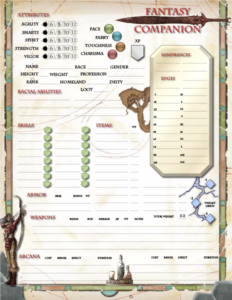
As the subject came up recently in the Swift d12 community, I thought it might be worth writing a blog post about character creation, giving an overview of the process and providing a few examples.
Character creation in Swift d12 is designed to be fast. Instead of building your character up from nothing, you start with an average-across-the-board baseline and then adjust it, applying bonuses and penalties to make the character unique.
The same concept can also be applied to NPCs, making it easy to create them on the fly; a typical enemy NPC would just have +0 in everything. Creating tougher foes can be as simple as giving them a +1 or +2 in everything. Particularly weak characters might even have negative abilities (for example, a peasant would probably have Combat -1).
Races
Each race provides a combination of benefits and drawbacks, with a total worth that's fairly comparable with a regular Feat. The available races are defined by the setting (Saga of the Goblin Horde has bugbear, goblin, gremlin, half-human and hobgoblin).
Primary Abilities
There are six primary abilities, and they start at +0. Each race grants +1 to one primary ability, and players may also increase one primary ability of their choice by +1, as well as (optionally) moving 1 point from one or two primary abilities to another. The total of all primary abilities for a starting character will therefore add up to +2.
The primary abilities are Strength, Agility, Endurance, Cunning, Instincts and Dominance. The ability names are flavored for Saga of the Goblin Horde; the generic version of Swift d12 will probably use more traditional ability names.
Secondary Abilities
Each character also has two secondary abilities, Combat and Magic. These start at +0, and can only be increased with Class Feats.
Note that even Combat +0 indicates reasonable competence at fighting. In settings where this isn't always appropriate, there might be a "Non-Combatant" Flaw or something similar.
Derived Traits
Each character has four derived traits. Speed indicates how far you can move each round. Resilience represents how resistant you are to injury (it is 5 + Size + Constitution + Armor), Capacity indicates how many “significant items” you can carry (3 + Strength) without penalty, and Leadership (3 + Dominance + 1 per Class Feat) is used in Saga of the Goblin Horde to indicate how many gang members you have.
Skills
Each ability has four skills, representing exceptional capabilities beyond the innate talent and training implied by abilities. Most people (and starting characters) have +0 in everything, representing average competence across the board. Each skill has specific uses, but to keep this short I'll just list them by name:
Strength: Climb, Jump, Muscle, Swim
Agility: Dexterity, Reflexes, Ride, Stealth
Endurance: Concentration, Fortitude, Stamina, Vitality
Cunning: Appraise, Craft, Lore, Wits
Instincts: Perception, Search, Survival, Willpower
Dominance: Bluff, Diplomacy, Husbandry, Intimidate
Combat: Brawl, Melee, Shoot, Throw
Magic: Conjuration, Divination, Enchantment, Invocation
Skills based on primary abilities are called "primary skills", while those tied to secondary abilities are called "secondary skills". Whenever a character makes an ability check, they add their ability and skill modifiers to the d12 roll, subtract any penalties, and require 7+ ("lucky 7") to succeed.
Flaws
Each player can choose two Major Flaws, four Minor Flaws, or one Major and two Minor Flaws. Flaws are defined as either Handicaps (crunchy, incur an actual mechanical penalty) or Quirks (fluffy, roleplaying only). Minor/Major Handicap Flaws allow you to add +1/+2 to a primary skill of your choice as compensation.
Here are a couple of examples:
Proud [Minor/Major Quirk]
This individual has an overinflated opinion of his own importance and accomplishments, and little respect for the achievements of others. As a Minor Flaw he might just be vain or willful, while as a Major Flaw he would kill or die to protect his fragile ego.
Pungent [Minor/Major Handicap]
This goblin suffers from a very ripe and overpowering body odor, making him particularly easy for enemies to smell. This usually only applies when he is quite close to the enemy, or upwind of them, unless they have an exceptionally sharp sense of smell. As a Minor Flaw the character suffers a -1 penalty to Stealth checks in situations where the enemy can smell him, and they receive a +1 bonus to Survival checks when trying to track him. As a Major Flaw, the penalty increases to -2 and the bonus increases to +2.
Feats
Each player starts with one Class Feat and two other Feats of their choice. They gain another Feat every time they gain a level. Every four levels (i.e., level 4, 8, 12, etc) they gain a Class Feat, at other levels they gain any other Feat for which they qualify.
There are three Class Feats: Savant, Scrapper and Sorcerer. Scrapper gives you a +1 bonus to Combat, Sorcerer gives you a +1 bonus to Magic, and Savant gives you a bonus to two different skills of your choice (+2 to a primary skill, or +1 to a secondary skill). Each Class Feat can be taken a maximum of three times, and you can mix and match if you wish. Savant cannot be applied to the same skill more than once, but allows you to increase the skill bonus beyond the normal maximum (so Savants dominate in their fields of specialty).
The other Feats provide a wide range of different benefits (Ambidexterity, Quick Draw, Weapon Finesse, and so on), but are approximately half as powerful as Class Feats. The other Feat categories are Combat Feats (Scrapper only), Magic Feats (Sorcerer only), Expert Feats (Savant only), Common Feats (available to everyone) and Legacy Feats (can only be taken during character creation).
Example 1
Bob wants to play a bugbear warrior, so he chooses the bugbear race, which gives him Strength +1. He then chooses to increase Strength again as his free bonus ability, then move a point of Cunning to Endurance. He now has Strength +2, Endurance +1, and Cunning -1.
Bob decides to take two Major Flaws: Gluttonous and Ignorant. Ignorant is a Handicap, giving him a -2 penalty to the Lore skill, which means he's allowed to add +2 to another primary skill of his choice. He chooses Intimidate +2. He also gains Stealth +1 as a bugbear racial bonus.
Bob takes Scrapper as his Class Feat (giving him Combat +1), and for his other two Feats he chooses Cleaving Blow and Thick Fur.
Example 2
Buffy wants to play a goblin scout, so she chooses the goblin race, which gives her Agility +1. She then chooses to increase Instincts to +1 as her free bonus ability.
Buffy decides to take one Major Flaws (Snobgoblin) and two Minor Flaws (Blood Oath and Foible), but these are all Quirks, so she doesn't gain any skill modifiers from them. However she does gain Stealth +1 and Survival +1 as goblin racial bonuses.
Buffy takes Savant as her Class Feat, using it to boost Shoot (primary skill) by +1 and Stealth (secondary skill) by +2. For her other two Feats she chooses Skill Focus (boosting Stealth and Survival by another +1 each) and Fast Reflexes.
Buffy wants to play a goblin scout, so she chooses the goblin race, which gives her Agility +1. She then chooses to increase Instincts to +1 as her free bonus ability.
Buffy decides to take one Major Flaws (Snobgoblin) and two Minor Flaws (Blood Oath and Foible), but these are all Quirks, so she doesn't gain any skill modifiers from them. However she does gain Stealth +1 and Survival +1 as goblin racial bonuses.
Buffy takes Savant as her Class Feat, using it to boost Shoot (primary skill) by +1 and Stealth (secondary skill) by +2. For her other two Feats she chooses Skill Focus (boosting Stealth and Survival by another +1 each) and Fast Reflexes.
Example 3
Joe wants to play a goblin pyromancer, so he chooses the goblin race, which gives him Agility +1. He then chooses to increase Cunning as his free bonus ability, then move a point of Strength to Cunning as well. He now has Strength -1, Agility +1, and Cunning +2.
Joe decides to take one Major Flaw (Obsession) and two Minor Flaws (Foible and Hideous). Hideous is a Handicap, giving him a -1 penalty to the Diplomacy skill, which means he's allowed to add +1 to another primary skill of his choice. He chooses Concentration +1. He also gains Stealth +1 and Survival +1 as goblin racial bonuses.
Joe takes Sorcerer as his Class Feat (giving him Magic +1), and for his other two Feats he chooses Skill Focus (boosting the Invocation primary skill to +1) and Elementalist.
Joe wants to play a goblin pyromancer, so he chooses the goblin race, which gives him Agility +1. He then chooses to increase Cunning as his free bonus ability, then move a point of Strength to Cunning as well. He now has Strength -1, Agility +1, and Cunning +2.
Joe decides to take one Major Flaw (Obsession) and two Minor Flaws (Foible and Hideous). Hideous is a Handicap, giving him a -1 penalty to the Diplomacy skill, which means he's allowed to add +1 to another primary skill of his choice. He chooses Concentration +1. He also gains Stealth +1 and Survival +1 as goblin racial bonuses.
Joe takes Sorcerer as his Class Feat (giving him Magic +1), and for his other two Feats he chooses Skill Focus (boosting the Invocation primary skill to +1) and Elementalist.