Sunday, 5 July 2015

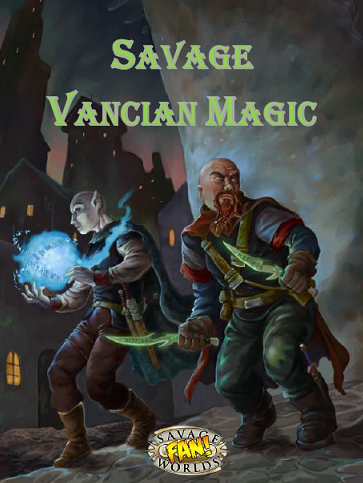
Savage Vancian Magic


Vancian magic (aka "fire and forget") seems to be one of those things that some people love and others hate. Although freeform magic is still probably my favorite approach in general, I was introduced to the Dragonlance novels at a young age, and Raistlin made a lasting impression on me.

More recently I've been interested in converting 3.x material to Savage Worlds, particularly the excellent War of the Burning Sky adventure path. I originally came up with a simple “Fast, Furious and Fun” solution for handling spellcasters (see the Arcane Backgrounds in Savage War of the Burning Sky), and used trappings to cover their spells (such as those in my Savage Spellbook supplement), but as the campaign progressed and the PCs advanced (and the wizard's player wanted to use the same sort of spells that had been available in our former D&D 3.5 campaign) my solution felt increasingly like trying to fit a square peg into a round hole. It just didn't capture the feel, the flavor, of the magic system. So after running a couple of dozens gaming sessions I went back to the drawing board and tried again, and this is the result.

It's perfectly possible to play a superhero game in Savage Worlds using just the core rules, but I find it much easier with the Super Powers Companion, which offers an alternative power system specifically geared towards supers settings. Savage Vancian Magic does exactly the same thing for D&D/Pathfinder settings. Neither the Super Powers Companion nor Savage Vancian Magic are required, but they are both designed to make the GM's job easier when running certain types of campaign.

You can download it from here: Savage Vancian Magic

The goal
"I love Savage Worlds. Half of the guys in my group love Savage Worlds. But part of what keeps the other half from jumping on board, at least for a fantasy campaign, is the lack of a Vancian magic system"
"But when it comes to fantasy, Vancian magic is hard coded into many gamers’ DNA. That’s certainly the case in my group – they like Savage Worlds well enough, but the lack of a Vancian magic system is a major stumbling block. They like being able to learn a large number of spells, and cherrypick from them each session. The Fantasy Companion doesn’t address that need, which is a shame since its addition could have won over some of the holdouts."
"SW is bad at settings with tons of weak magic spells. The average magic user in Savage Worlds has half a dozen quite powerful spells, most of them geared towards combat. If you want a game where the magic user has a lot of weak utility spells, and part of your fun is to find creative ways to use and exploit them, Savage Worlds is not the game for you."
The goal of Savage Vancian Magic is to capture the flavor of the 3.x magic system in a way that still feels like Savage Worlds. It is specifically aimed at people who want to play Savage Worlds, but also want 3.x–style spellcasters. Despite its name, this supplement covers both Vancian (i.e., “prepared”) and non–Vancian (i.e., “spontaneous”) spellcasters.

If you hate the 3.x magic system, you probably won't find Savage Vancian Magic useful – except perhaps as proof of concept, to demonstrate the versatility of Savage Worlds, and prove to the naysayers that even their sacred cow can be Savaged.

If you hate long spell lists then you definitely won't like this, but should instead take a look at my Savage Abilities supplement, which takes the opposite approach - it trims all the fat, reducing the power list to just five different powers. Those five powers can then be customised with modifiers and trappings to design a huge range of custom spell effects.

It should also be noted that this magic system differs from the magic in Jack Vance's work, as it’s inspired by the 3.x approach rather than Vance’s novels, however the commonly used term for both is still "Vancian magic".


Wednesday, 24 June 2015

The Thin Blue Line - A Detroit Police Story

The latest project by Melior Via (the company behind Accursed) is a modern urban fantasy setting, which focuses on the paranormal investigations of the psychically gifted police officers of Corktown Precinct.

John Dunn offered to let me have a sneak peek at the current draft of the player's guide, so I thought I'd give a quick overview in case anyone else was interested in the project. I will focus mainly on the crunch because that's the area I know best.

Chapter 1: Detroit History

The first chapter is 39 pages, around a quarter of which covers the history of Detroit, the rest describing the neighborhoods and regions of interest, along with some maps. Most of the information is based on real-world history and geography, but there are also subsections covering supernatural activity.

Someone who is already familiar with the history of Detroit might already know some of this information, but for anyone else the chapter is invaluable. It's also well organised, broken down into separate sections that each cover different parts of the setting.

Chapter 2: Corktown Precinct

This chapter is 11 pages, and focuses on Corktown Precinct and the police force. It delves more deeply into the supernatural side of things, describes the various ranks and roles of the police officers, and explains the recruitment and training process.

Chapter 3: Fresh Recruits

This chapter is 11 pages, and covers character creation, setting rules, Edges and Hindrances.

Everyone begins with Knowledge (Law) d6 for free, which feels a bit excessive to me - I'd expect a typical lawyer to have Knowledge (Law) d6, but for most police officers I would rely on Common Knowledge. Savage Worlds Deluxe actually uses a lawyer with Knowledge (Law) d4 in one of its examples, and none of the Police stats in the Horror Companion have Knowledge (Law) at all.

Characters are also required to take at least d4 in Driving, Fighting, Guts and Shooting, which seems pretty reasonable. However the fact that they're not freebies, and that Legal Authority is explicitly defined as an Edge rather than a setting rule, would imply to me that PCs don't need to be police officers if they don't want to be - a common trope in urban fantasy, where the supernaturally-gifted civilian protagonist is occasionally called upon for their expertise. I don't know whether that is the intent, but I think it would make a fun option, even if it's only included as a footnote.

Setting Rules

  • Just as Lucky: This rule was also used in Accursed, although I'm not overly fond of it for reasons I've outlined before.
  • Lost Illusions: Like "Damaged Characters" from Accursed.
  • Reason and Delirium: A new mechanic, somewhat reminiscent of the Roads/Paths in WoD. It's an interesting idea that fits the setting like a glove, and I think I prefer it to the sanity mechanics I've seen in other settings.
  • Skills: Like in Accursed, Guts is used for Fear checks, Climbing and Swimming are merged into Athletics, while Lockpicking and Stealth are merged into Subterfuge. Two new specific Knowledges (Forensics and Parapsychology) are also included, and they're a good fit for the setting.

As with Accursed, a few Edges and Hindrances are also included from the Horror Companion, although you could ignore them if you didn't want to purchase an extra book.

Hindrances

There are four new Hindrances. Disrupted Psyche is like Cursed from the Horror Companion, except it works against Psychic powers rather than Miracles, and has been reduced to a Minor Hindrance. Glass Jaw has shown up in other settings. The other two are more interesting (and unique as far as I'm aware): Gambler and Haunted.

Edges

There are two new Arcane Backgrounds and five new Edges (although one of those is Dirty Fighter, which has appeared in other settings). The Edges don't explicitly list their categories; Parapsychologist looks like a Professional Edge, but it would be nice to know for sure (because of the rules for stacking bonuses).

Chapter 4: Parapsychology

This chapter is 12 pages, and details the new Arcane Backgrounds and their powers, including 14 new powers geared towards different types of psychic characters. Most of the powers look pretty good, the only one I'd take exception to is Autodidact (+6 to any Knowledge skill of your choice with a duration in hours) - I'd personally reduce the bonus to +2 (the same as the Scholar Edge).

As well as Psychics, there are also rules for Nullifiers - characters who are able to block the supernatural powers of others. I wasn't too sure about treating them as an Arcane Background initially, but after reading the extensive flavour text I think it's a good fit.

The chapter finishes up with a few pages on paranormal phenomena and rival organisations.

Chapter 5: Gear Locker

This chapter is 10 pages, and covers equipment and vehicles. There's a lot of gear listed, some of it is the same as SWD and some of it is new. Most of it looks pretty good, although there are a few areas I'm hoping the writers will take another look at before publishing, in particular:
  • Tasers are described but don't have any stats yet. Hopefully they won't work the same as ETU (I explained here why I dislike their version).
  • Splinter Rounds give a +2 bonus to Shooting rolls (the same as shot) but it's not clear whether they inflict the same damage as shot (1-3d6 depending on range) or as slugs (2d10).
  • Cold Iron Rounds gain +2 AP against creatures vulnerable to cold iron, which seems a bit arbitrary; if a fae is vulnerable to cold iron, surely they would still benefit from wearing physical armour?
  • M84 Stun Grenade are described as being "used to blind and deafen enemies", but they don't actually cause either outcome, only Shaken. I would have expected them to work a bit like the Blind power with the Sound (Deafen) trapping from SWD.
  • Tear Gas Grenades also cause only Shaken, which (particularly considering the new Shaken rule) makes it a very weak option that will barely slow most foes down. The same with the Paranormal Irritant Spray. I would have thought Fatigue might be more appropriate.
  • Riot helmets are only 50% effective against head shots, the same as a pot helm - however unlike a pot helm, they have a polycarbonate visor. Helms with visors are usually 100% effective against head shots.
  • Motorcycle jackets provide the same protection as chainmail, which seems quite a lot. Even providing the same protection as leather armour would seem quite generous to me (I usually just treat them as reinforced clothing; +1 armour unless you're hit with a raise).
Summary

The version I looked at is still a draft, but it's packed full of good content and is clearly close to completion. It actually reminds me a bit of the novel "Rivers of London" (called "Midnight Riot" in the US) by Ben Aaronovitch, except based in Detroit rather than London, and I can definitely see it appealing to fans of urban fantasy.

You can check out the Kickstarter here, and view the website here. I will definitely be backing this one.

Wednesday, 17 June 2015

Converting D&D Armor and Shield Enchantments

In a previous post I discussed my ideas for converting magic weapons from D&D to Savage Worlds. This time I'm going to cover armor and shields.

The concept is pretty much the same, although one notable difference is that some of the magic bonuses for D&D armor and shields have a purely financial cost instead of a numeric bonus value. To keep things simple, I chose to stick to numeric bonuses (+1, +2, etc.). Some of the bonuses have also been merged (e.g., "Shadow" and "Silent Moves") or streamlined.

Standard Enchantments

Most magic armor and shields in D&D have a simple fixed bonus in the range +1 to +5, which is applied directly to the wearer's Armor Class. However Savage Worlds is far less granular, and even +1 armor is a potent bonus, so here is the approach I recommend.

+1 Armor: +1 armor, reduced to +0 if hit with a raise.
+2 Armor: +1 armor.
+3 Armor: +2 armor, reduced to +1 if hit with a raise.
+4 Armor: +2 armor.
+5 Armor: +3 armor, reduced to +2 if hit with a raise.

+1 Shield: +1 armor against ranged shots.
+2 Shield: +2 armor against ranged shots.
+3 Shield: +1 Parry.
+4 Shield: +1 Parry, and +1 armor against ranged shots that hit.
+5 Shield: +1 Parry, and +2 armor against ranged shots that hit.

This is also consistent with the ability prices listed in Savage Armoury. Note that if you're using Savage Armoury as well, enchanted weapons and armor should always have the Masterwork ability.

Special Enchantments

The following are some proposed conversions of the special armor and shield abilities used in D&D. As with the weapons, the goal is to retain the general flavor of the original ability, while significantly toning down the mechanical benefits to match those described earlier.

Acid Resistance (+1/+2): Acid damage against the wearer is reduced by 2 or 4 points.

Animated (+2): As a normal action you can release this shield from your hand, causing it to float beside you and protect you as if you were holding it. This is treated as if you were holding the shield for all purposes (including encumbrance and Arcane Spell Failure), except that you can use your hand for other things. You can grasp the shield again at any time as a free action, and cannot activate more than one Animated shield at a time.

Arrow Catching (+1): This shield can be activated as a normal action and deactivated as a free action. While active it attracts arrows, thrown weapons, and other ranged attacks, causing them to veer unerringly towards it. Any ranged attacks made against targets adjacent to you are automatically diverted towards you instead. All ranged attacks against you receive a +1 bonus to hit and halve any penalties for obscurement or poor lighting, but don't inflict any additional damage for Called Shots or raises, as they invariably strike the center of your shield. This ability does not work against spells or area-effect attacks, nor against particularly large attacks such as siege weapons.

Arrow Deflection (+2): This shield can be used once per round to try and deflect a ranged attack that would normally hit you, as long as you are aware of it and not Shaken; make an opposed Agility roll against the attack roll, if you win then the attack is deflected and misses you. This ability does not work against spells or area-effect attacks, nor against particularly large attacks such as siege weapons.

Bashing (+1): This shield inflicts +1 damage when used to make a Shield Bash maneuver.

Blinding (+1): This shield can unleash a flash of brilliant light up to twice per day as a normal action, filling an area the size of a Large Burst Template centered on the character. Everyone within the area (other than the character) must make a standard (TN 4) Agility roll or become Shaken; if a target rolls 1 on their Agility die (or rolls a critical failure if they're a Wild Card) they are also blinded until they recover from being Shaken.

Cold Resistance (+1/+2): Cold damage against the wearer is reduced by 2 or 4 points.

Electricity Resistance (+1/+2): Electricity damage against the wearer is reduced by 2 or 4 points.

Etherealness (+3): This armor allows the wearer to cast Intangibility on themselves, using Spirit for the arcane skill roll; the armor has 5 Power Points for this power.

Fire Resistance (+1/+2): Fire damage against the wearer is reduced by 2 or 4 points.

Fortification (+1/+2): This armor or shield produces a magical force which protects the vitals. Additional damage caused by Called Shots is reduced by 2 or 4.

Ghost Touch (+3): This armor or shield protects against both ethereal and non-ethereal creatures. It can also be picked up and used by ethereal creatures.

Glamoured (+1): This armor can take on the illusionary appearance of a normal set of clothing, although it still retains its normal weight and provides its normal protection. The illusionary appearance is always the same, but remains active as long as the wearer wishes; switching the illusion on or off is a normal action.

Invulnerability (+3): This armor increases the wearer's Vigor by +1 die step.

Reflecting (+5): This shield can be used once per day to reflect a spell that targets you personally (i.e., it doesn't work against area effect spells). Make a standard (TN 4) Spirit roll, with a -2 penalty if the spell was cast with a raise: on a failure you are affected by the spell, while on a success the spell is reflected back on the caster.

Shadowy (+1/+2): This armor grants you a +1 or +2 bonus to Stealth rolls when attempting to move silently or remain unseen.

Slick (+1): This armor grants you a +2 bonus to resist and escape from grapple, constrict, Entangle, and other forms of confinement.

Sonic Resistance (+1/+2): Sonic damage against the wearer is reduced by 2 or 4 points.

Spell Resistance (+2/+4): This armor grants the wearer a +1 or +2 bonus to resist opposed magic, as well as +1 or +2 armor against damage-causing magic.

Undead Controlling (+3): This armor or shield grants the wearer the ability to cast Puppet on any creature with the Undead ability, using Spirit for the arcane skill roll; the armor has 5 Power Points for this power.

Wild (+3): This armor or shield continues to provides its armor and Parry bonuses to the wearer while they are shapechanged into the form of an animal.

Tuesday, 9 June 2015

Monster Builder

A couple of weeks ago someone on Google+ asked if there were any resources for simple monster creation - a sort of "dummies guide". I thought that sounded like a good idea, as I often see people making mistakes when writing up monsters (particularly with Parry and Toughness), so I put together a tool for it. 

You can access it here: Monster Builder

It's designed to be quick and easy to use, so it doesn't offer the same amount of detail as some of my other tools, but it might be helpful for people who don't yet have much experience with building monsters.

Wednesday, 29 April 2015

Converting D&D Weapon Enchantments

Converting magic weapons from D&D to Savage Worlds is a subject that's been raised on a number of occasions, particularly by people who are interested in adapting various campaign settings and Adventure Paths.

I've discussed my ideas for weapon conversions in general terms in the past, however my upcoming Vancian magic system needs something more concrete (particularly for the artificers), so I decided it was time to flesh out some actual guidelines.

Standard Enchantments

Most magic weapons in D&D have a simple fixed bonus in the range +1 to +5, which is applied to both attack and damage rolls. However Savage Worlds is far less granular, and even +1 to attack and damage is a very potent bonus, so here is the approach I recommend.

+1 Weapon: +1 damage on a raise.
+2 Weapon: +1 damage.
+3 Weapon: +1 to attack rolls.
+4 Weapon: +1 to attack rolls and +1 damage on a raise.
+5 Weapon: +1 to attack rolls and +1 damage.

This is also consistent with the weapon ability prices listed in Savage Armoury. Note that if you're using Savage Armoury as well, an enchanted weapon should always have the Masterwork weapon ability.

Special Enchantments

The following are some proposed conversions of the special weapon abilities used in D&D. The goal is to retain the general flavour of the original ability, while significantly toning down the mechanical benefits to match those described earlier. These also reference certain monstrous abilities (such as alignment-based abilities for supernatural creatures) which I use in my monster conversions - if you don't use those monstrous abilities, you can just base it on GM's discretion (which is how "good" and "evil" are normally defined in the core rules for the purposes of Edges such as Champion and Holy/Unholy Warrior).

Anarchic (+2): This weapon has been infused with the power of chaos. It counts as Chaotic for the purposes of Physical Resistance, and also inflicts +2 damage to creatures with the Lawful ability.

Axiomatic (+2): This weapon has been infused with the power of law. It counts as Lawful for the purposes of Physical Resistance, and also inflicts +2 damage to creatures with the Chaotic ability.

Bane (+1): This weapon is designed to kill a specific type of foe, such as humans, elves, dragons, etc, chosen when the weapon was forged. It inflicts +2 damage to creatures of the chosen type.

Brilliant Energy (+4): The striking part of this weapon has been transformed into intense light, causing it to illuminate an area the size of a Large Burst Template when drawn. This weapon ignores armour, as well as Parry bonuses from shields and weapons, but can only harm living matter; it inflicts no damage to undead, constructs, or inanimate objects.

Dancing (+4): As a normal action you can release this weapon from your hand, causing it to float beside you and fight your enemies. This is resolved as if you had a free attack at -2 each round; this must be a normal attack. You can grasp the weapon in your hand again as a free action, deactivating its Dancing power. You can only activate one Dancing weapon at any one time, and if you draw Clubs for initiative while the weapon is already active, it will automatically return to your hand at the end of your turn.

Defending (+1): The wielder of this melee weapon can use the Defend maneuver as a normal action if they wish, allowing them to perform other actions on the same turn (with the standard multiaction penalty).

Disruption (+2): This weapon inflicts +2 damage to undead, and if they are incapacitated by the attack they are automatically destroyed.

Distance (+1): This ranged weapon has its base range increased by +1/+2/+4 (missile weapons that use Shooting typically have their base range doubled, or tripled if they require both hands to use, see Savage Armoury for details).

Flaming (+1): This weapon bursts into flames on command as a free action. While flaming, the weapon illuminates an area the size of a Medium Burst Template, and any flammable targets struck by the weapon must roll to see if they catch fire. The damage caused by this weapon can be treated as either physical or fire, whichever is most effective against a particular foe.

Flaming Burst (+2): This weapon works like a Flaming weapon, except that when it hits with a raise it also explodes with flame, inflicting +d10 fire damage instead of the normal +d6 damage (the bonus die is always fire damage).

Frost (+1): This weapon becomes coated in frost on command as a free action. While frosty, the weapon gains AP 1. The damage caused by this weapon can be treated as either physical or cold, whichever is most effective against a particular foe.

Ghost Touch (+1): This weapon is capable of harming both ethereal and non-ethereal creatures. It can also be picked up and wielded by ethereal creatures.

Holy (+2): This weapon has been infused with holy power. It counts as Holy for the purposes of Physical Resistance, and also inflicts +2 damage to creatures with the Evil ability.

Icy Burst (+2): This weapon works like a Frost weapon, except that when it hits with a raise it also explodes with frost, inflicting +d10 cold damage instead of the normal +d6 damage (the bonus die is always cold damage).

Keen (+1): This piercing or slashing weapon is particularly sharp. If it hits with two or more raises, it inflicts a further +d4 damage (on top of the standard +d6 damage for a single raise).

Ki Focus (+1): This weapon channels the wielder's ki. If the wielder has the Adept Edge, and uses it to gain AP 2 until their next action, the AP applies to attacks made with this weapon in addition to unarmed attacks.

Merciful (+1): This weapon can be used to inflict nonlethal damage without incurring a penalty to the attack roll.

Mighty Cleaving (+1): If the wielder of this weapon has the Cleaving Blow Edge, they can now use it twice per round, although not on the same foe.

Returning (+1): This throwing weapon can be summoned back your hand as a action, as long as it's within its maximum range. This is the same as readying a weapon, meaning that if you have Quick Draw you can summon the weapon back to your hand as a free action.

Seeking (+1): This ranged weapon can ignore up to 1 point of attack penalty from cover or concealment (but not both at the same time).

Shock (+1): This weapon becomes wreathed in electricity on command as a free action. While electrified, the weapon illuminates an area the size of a Small Burst Template, and gains AP 1 against metal armour. The damage caused by this weapon can be treated as either physical or electricity, whichever is most effective against a particular foe.

Shocking Burst (+2): This weapon works like a Shock weapon, except that when it hits with a raise it also explodes with lightning, inflicting +d10 electricity damage instead of the normal +d6 damage (the bonus die is always electricity damage).

Speed (+3): This weapon allows you to make an additional attack when using it to perform an attack action. When you use this ability, roll an extra Fighting die with your attack roll, and apply a -1 penalty to all of your attacks for the turn.

Spell Storing (+1): This weapon can store a single Novice or Seasoned spell, which must be cast into it; the caster cannot recover their Power Points until the spell is discharged. Whenever you strike a foe with a raise, you may choose to discharge the spell as a free action instead of adding the standard +d6 damage for a raise. The arcane skill roll for the spell is made when the spell is discharged, not when it is placed into the weapon; if the roll results in Backlash, apply it to the wielder rather than the spellcaster.

Thundering (+1): Whenever this weapon hits with a raise, it releases a thundering roar, inflicting +d10 sonic damage instead of the normal +d6 damage. This sound can be heard from quite a long distance away. Creatures incapacitated by this damage always suffer deafness instead of rolling for a random injury.

Throwing (+1): This melee weapon can now be thrown with a range of 3/6/12.

Unholy (+2): This weapon has been infused with unholy power. It counts as Unholy for the purposes of Physical Resistance, and also inflicts +2 damage to creatures with the Good ability.

Vicious (+1): This melee weapon inflicts +2 damage, but it also inflicts half as much damage to the wielder (rounded down) as it does to the victim - e.g., if you hit someone for 15 damage, you also suffer 7 damage yourself.

Vorpal (+5): This exceedingly sharp weapon inflicts +d6 damage die for every raise on the attack roll (rather than just the first raise). If you incapacitate a foe with a vorpal weapon, they are automatically decapitated.

Wounding (+2): This weapon causes particular horrible wounds; Soak rolls against damage inflicted by this weapon suffer a -2 penalty. Creatures who don't suffer additional damage from Called Shots (such as undead and constructs) are not affected by this weapon.

Tuesday, 28 April 2015

Immortality and the Price of Death


Savage Insider volume 3 issue 1 includes another article of mine: Back from the Dead. The article discusses various different solutions for designing characters who cheat death, based on the following observations about the rules  in Savage Worlds Deluxe:

1. The "Character Creation" chapter stresses that you should play a character you enjoy.

2. The "Background Details" section encourages players to make up their own history and background.

3. The "Replacement Characters" rule states that "When a character dies, his new hero begins play with one less Advance than his last."

So by a strict interpretation of the rules, it's perfectly legal to recreate the same character (with one fewer Advance) every time they die, and simply explain in your background history that your character is immortal.  At the very least, it'll save you the effort of explaining how a new PC joins the group in the middle of the wilderness!

While many GMs might refuse to allow such a character concept, that's not really the point of the article. The point is that we can now assign a specific price to death in Savage Worlds: Death costs one advance.

Once we know that, we can extrapolate, and that's what I do throughout the rest of the article. Resurrection can now be handled with standard Powers and rules, immortality can be covered by applying trappings to existing Edges and Hindrances, immortal(ish) races such as Time Lords and the Goa'uld can now be easily balanced against other races, and so on. I finish up the article with a new Edge (Immortal) and three new Hindrances (Curse of Eternity, Dark Appetite, and Phylactery).

Further Thoughts
"You, Kallor Eiderann Tes'thesula, shall know mortal life unending. Mortal, in the ravages of age, in the pain of wounds and the anguish of despair. In dreams brought to ruin. In love withered. In the shadow of Death's spectre, ever a threat to end what you will not relinquish. Kallor Eiderann Tes'thesula, you shall never ascend. Kallor Eiderann Tes'thesula, each time you rise, you shall then fall. All that you achieve shall turn to dust in your hands. As you have wilfully done here, so it shall be in turn visited upon all that you do. Three voices curse you. It is done."
-- Memories of Ice (Malazan Book Of The Fallen 3)
The Harder to Kill Edge gives you a 50% chance of avoiding death, which (when applied to an "immortal" character concept) would mean that death now costs you only half an advance on average. A GM who wanted to explore the concept of unkillable characters (without applying it to everyone as a setting rule) could even take the Edge a step further...

Impossible to Kill
Requirements: Legendary, Harder to Kill
  You can no longer be killed, although you can still be beaten, incapacitated, captured, and even dismembered. You no longer suffer permanent injuries, they always go away when all of your wounds have healed.

Of course "unkillable" is not the same as "invulnerable"; a cocky PC who crosses the wrong people could still be put out of action, waiting out eternity at the bottom of a lake in a pair of concrete boots.


Monday, 13 April 2015

Granular Advancement

By the RAW, characters in Savage Worlds earn 1-3 experience points per session, although in practice it usually works out at 2-3 for most groups - and as 5 experience points grant an Advance, some GMs find it easier to simply award everyone half an Advance per session. This means that PCs can improve something every two sessions.

Some GMs dislike characters advancing every two sessions, and instead prefer to double the number of experience points earned, so that PCs gain one Advance every session. The obvious drawback of awarding double experience points is that the PCs advance at twice the recommended speed, and can rapidly outpace the challenges in a campaign designed for characters using the normal advancement rules.

One Advance can be used to raise an attribute, buy an Edge, buy a new skill at d4, raise a skill above its linked attribute, or raise two skills below their linked attribute. But if PCs can raise two skills below their linked attribute for one Advance, why not let them raise one skill below its linked attribute for half an Advance?

You can still rule that characters cannot raise the same skill twice in succession if you wish to retain the "raise two different skills" limitation, but allowing PCs to spend half an Advance at a time means there is the possibility for improvement every gaming session.

But that's just skills. Can the same concept be extended to attributes and Edges as well?

Odd Traits

There have been several discussions in the past about the pros and cons of extending trait progression using d14, d16, d18, d20, d22 and d24, instead of applying fixed bonuses after d12. But what about inserting additional die steps in between the existing trait progression dice?

Introducing a d5, d7, d9 and d11 would allow characters to raise their attributes in smaller increments, for example a PC could increase their Strength from d6 to d7 for half an Advance, then increase it again to d8 with their next half Advance if they wished.

The same approach could be used for skills: if you had Agility d7 then increasing Fighting from d6 to d7 would cost quarter of an Advance, while increasing it from d7 to d8 would cost half an Advance.

Note that Derived Statistics are already rounded down (e.g., Vigor d12+1 gives Toughness 8 rather than 9), so increasing Vigor or Fighting to an odd die step would not be exploitable in that respect.

Minor Edges

In Savage Abilities I introduced the idea of Minor Edges - Savage Worlds already splits Hindrances into Minor and Major, after all, so why not do the same for Edges?

Some Edges provide +2 bonuses which could be halved, for example a Minor version of Attractive might just give +1 Charisma, while a Minor version of Alertness might give +1 to Notice rolls.

Another option is to make an Edge more specialised, for example a Minor version of Alertness could grant its +2 bonus to one specific sense rather than all senses, while a Minor version of Beast Bond might apply to one specific animal rather than every animal under your control.

Other Edges provide multiple benefits which could be divided up, for example Beast Master might be split into Animal Empathy (animals don't attack you) and Animal Companion (you have a loyal animal companion), while Strong Willed might have its Intimidation and Taunt bonuses separated into two Minor Edges.

Particularly weak Edges such as Bruiser or Combat Reflexes could also be downgraded to Minor Edges, at the GM's discretion.

Semi-Skilled

Characters can purchase a new skill at d4 for a full Advance, which effectively negates the -2 penalty for being unskilled. By extension, it should be possible for someone to become partially skilled (going from d4-2 to d4-1) for half an Advance, representing a character who is still learning the ropes but is no longer completely clueless.

Summary

Although this proposal has additional benefits (such as increasing character diversity by allowing smaller investments in specialised abilities), one of the main advantages is that PCs can advance in a more granular fashion. They can potentially gain or improve an ability every session, but overall they still progress at the same speed as the official rules.

From a terminology perspective it might be easier to refer to an Advance as a "Major Advance" and half an Advance as a "Minor Advance". PCs would then earn a Minor Advance each session, with two Minor Advances being worth a Major Advance. A Major Advance could be spent as described in the core rules, while each Minor Advance could be used for any or all of the following (at the GM's discretion):

  • Gain a new Minor Edge, or increase a Minor Edge to a Major Edge (if two versions are available).
  • Increase one skill that is equal or above its linked attribute by a minor increment (e.g., d6 to d7, or d7 to d8).
  • Increase two skills that are both below their linked attribute by a minor increment.
  • Increase one skill that is below its linked attribute by a major increment (e.g., d6 to d8).
  • Learn a new skill at d4-1 (semi-skilled), or increase it from d4-1 to d4.
  • Increase one attribute by a minor increment (this option can only be used twice per rank).

GMs using the "Spell Trappings" guidelines from Savage Spellbook might also allow characters to gain a single new trapping for a power they've already purchased with a Minor Advance. For example a character who had previously purchased New Power (with a Major Advance) to take Blast with the "Fireball" trapping could spend a Minor Advance to take "Ice Storm" as a second trapping for their Blast power.

Similarly, when using the "Skill Specialization" setting rule from SWD, one additional specialisation would cost a Minor Advance.