Wednesday, 5 August 2015

Expanded Rule: Sleeping Guards

There are no official rules on how to handle sleeping and waking,[Reference] although it's a subject that occasionally comes up during play. The closest we have to an official ruling is the Slumber power, which allows sleeping victims to make an unmodified Notice roll to wake up if they hear a "loud noise". Clint has also suggested that some GMs might choose to allow a Notice roll with a penalty if the sneaking character doesn't achieve a raise on their Stealth roll.[Reference]

When using Stealth to sneak up on someone, foes are classified as either active or inactive guards. A failed Stealth roll allows an inactive guard to make an unmodified Notice roll, and if successful they become an active guard for future rolls. Active guards can opposed the Stealth roll with a Notice roll in order to spot the character.

I therefore propose a third state: Sleeping.

When sneaking up on a sleeping guard, a failed Stealth roll indicates that you've made a noise, and they can make a Notice roll at -2 (the sleeping penalty): On a success they wake up and become inactive guards (they assume they just woke up naturally), while on a raise they wake up and become active guards (they know that a noise woke them up and are therefore more alert).

When taking the Last Step, if you don't achieve a raise on your Stealth roll then a sleeping foe can make an opposed Notice roll at -2 (the sleeping penalty). Of course even if they wake up, they will almost certainly be Prone and (unless they have natural weapons) count as an Unarmed Defender, at least until they've had their first action. Sleeping while on guard duty is a bad idea!

Note that the sleeping penalty should not apply to the Notice roll for Danger Sense. A sleeping character who successfully uses Danger Sense automatically wakes up and acts as if they'd been awake to start with.

New Hindrance

Deep Sleeper (Minor)
  You're a very heavy sleeper, and find it difficult to wake up. The penalty you suffer to Notice rolls while sleeping is increased to -4, and you cannot make opposed Notice rolls against the Last Step. A character with this Hindrance can never take Light Sleeper.

New Edge

Light Sleeper (Background)
Requirements: Novice, Notice d6+
  You sleep very lightly, and are always alert when you wake up. You ignore the -2 penalty to Notice rolls for sleeping. Furthermore if someone attempts to sneak up on you while you're asleep and fails their Stealth roll, a normal success on your Notice roll causes you to wake up and become an active guard, while on a raise you also wake up on Hold.
  When someone uses the Last Step against you, you may always attempt an opposed Notice roll, even if they succeeded with a raise on their Stealth roll. If you win the opposed roll you wake up and spot them, while beating them with a raise means you also wake up on Hold (and can attempt to immediately interrupt them if you wish).

Monday, 20 July 2015

Hindrance Cards

GMs in Savage Worlds are encouraged to hand out bennies when the players roleplay their Hindrances, although no specific guidelines are given - rewarding bennies falls very much into "GM's discretion" territory.

Personally I usually aim to award 1 benny per Hindrance per session. I will also give additional bennies for special cases, but those first 3 bennies tend to be the easiest to earn, particularly for crunchy Hindrances. For example I'd award a benny to a Lame character the first time they're in a Chase, or in a situation where their reduced Pace prevents them from completing a desirable action; I feel that it should be easier to earn bennies for crunchy Hindrances, to compensate for the fact that they also give a mechanical drawback (compared to the fluffy Hindrances that are purely roleplayed).

This approach works well for me, but sometimes I forget which PCs have which Hindrances, and which Hindrances I've already rewarded during the session. This becomes particularly problematic for one-shots and new campaigns, as it takes me a while to familiarise myself with the various PCs.

One solution I came up with is to write out the PCs Hindrances on cards (one Hindrance per card), and hand out the cards at the beginning of the session. The players can then cash in each of their cards when the respective Hindrances come into play, as long as their justification isn't too much of a stretch.

More recently I've had some newer players who aren't familiar with the system, and they sometimes have difficulty remembering what their Hindrances do (which can sometimes make it difficult to know when to cash in a card). So I decided to put together a tool that can generate printable cards complete with descriptions.

You can access it here: Hindrance Card Generator

Saturday, 11 July 2015

Savage Dragonmarks

Now that Savage Vancian Magic is complete, I thought it might be fun to take a look at some of the other ways in which the new spells can be used. One idea that immediately sprung to mind was the dragonmarks from Eberron - elaborate tattoo-like skin patterns that grant magical abilities.

Kristian Serrano's comprehensive Savage Worlds Eberron Conversion Companion does already include rules for dragonmarks, but they work more like traditional Arcane Backgrounds. The alternative solution I'm providing here is instead designed to complement the spells and Edges described in Savage Vancian Magic.

Dragonmark Edges

Only humans, halflings, elves, gnomes, dwarves, half-elves and half-orcs can take Dragonmark Edges. A character can either take Aberrant Dragonmark, Least Dragonmark, or Heir of Siberys, but each blocks the other two. If a character takes Least Dragonmark then they may later branch into Lesser Dragonmark, Greater Dragonmark and/or Dragonmark Heir.

Aberrant Dragonmark
Requirements: Novice, Special
  You cannot take this Edge if you already have a dragonmark. Choose one of the following spells when this Edge is first taken: Beguile Person, Cause Moderate Wounds, Chilling Touch, Cone of Fire, Feather Fall, Hovering Disk, Leap, Light, Produce Fire, Sense Hidden Doors, Shield of Force, Terror, or Traceless Step. You may cast your chosen spell once per day, using Spirit as the spellcasting skill. Your caster rank for this spell is the same as your character rank.

Least Dragonmark
Requirements: Novice, Special
  You cannot take this Edge if you already have a dragonmark. Choose one of the Marks available for your race when this Edge is first taken. You immediately gain the listed skill bonus. Select one of the Least spells available to your Mark: You may cast this spell once per day, or twice per day if it's a Cantrip, using Spirit as the spellcasting skill. Your caster rank for Dragonmark spells is Novice.

Lesser Dragonmark
Requirements: Seasoned, Least Dragonmark
  Select one of the Lesser spells available to your Mark: You may cast this spell once per day. You may also cast your Least spell an extra time each day. Your caster rank for Dragonmark spells is now Seasoned.

Greater Dragonmark
Requirements: Veteran, Lesser Dragonmark
  Select one of the Greater spells available to your Mark: You may cast this spell once per day. You may also cast both your Least and Lesser spells an extra time each day. Your caster rank for Dragonmark spells is now Veteran.

Dragonmark Heir
Requirements: Seasoned, Connections (House), Least Dragonmark
  You gain a +2 Charisma bonus when dealing with members of your own Dragonmark House. You may also choose an extra Least, Lesser and Greater spell from those available for your mark (or gain the ability to cast your existing spell an extra time each day); if you don't yet have the Lesser or Greater Dragonmark Edges, you must wait before choosing your extra Lesser and Greater spells respectively.

Heir of Siberys
Requirements: Heroic, Luck, Special
  You cannot take this Edge if you already have a dragonmark. Choose one of the Marks available for your race when this Edge is first taken, and select one of the Siberys spells available to your Mark: You may cast this spell once per day, or twice per day if you are Legendary rank, using Spirit as the spellcasting skill. Your caster rank for Dragonmark spells is the same as your character rank.

Dragonmarks

Each dragonmark lists the race that can take it, the skill bonus it provides, and the spells available for the Least, Lesser, Greater and Siberys version of the mark.

Mark of Detection
Race: Half-Elf
Skill: +1 to sight-based Notice rolls
Least: Sense Magic (Cantrip), Sense Poison (Cantrip)
Lesser: Sense Scrying, Sense Invisibility
Greater: Truesight
Siberys: Foreknowledge

Mark of Finding
Race: Half-Orc and Human
Skill: +1 to Notice rolls when searching an area
Least: Identify Object, Internal Compass (Cantrip), Find Object
Lesser: Guiding Hand, Find Creature
Greater: Find Route
Siberys: Find Location

Mark of Handling
Race: Human
Skill: +1 Charisma when dealing with animals
Least: Pacify Animals, Beguile Beast, Speak with Beasts
Lesser: Dominate Beast, Improved Enchant Claws
Greater: Enlarge Animals, Summon Animals (Veteran)
Siberys: Grant Sentience, Summon Animals (Heroic)

Mark of Healing
Race: Halfling
Skill: +1 to Healing rolls
Least: Cure Moderate Wounds, Restore Minor Vitality
Lesser: Cure Major Wounds, Cure Poison, Cure Disease, Restore Moderate Vitality
Greater: Heal
Siberys: Improved Heal

Mark of Hospitality
Race: Halfling
Skill: +1 to Persuasion rolls
Least: Purification (Cantrip), Prestidigitation (Cantrip), Invisible Servant
Lesser: Conjure Food and Water, Secure Lodge
Greater: Magnificent Feast, Extradimensional Dwelling
Siberys: Teleportation Device

Mark of Making
Race: Human
Skill: +1 to Repair rolls
Least: Improved Mend Object, Mend Object (Cantrip), Mend Moderate Damage
Lesser: Create Object, Mend Major Damage
Greater: Fabricate Object, Improved Create Object
Siberys: True Creation*

Mark of Passage
Race: Human
Skill: +1 to Survival rolls
Least: Expeditious Jog, Summon Steed, Dimension Leap*
Lesser: Minor Teleport, Ghostly Steed
Greater: Improved Flight, Teleportation
Siberys: Improved Teleportation

Mark of Scribing
Race: Gnome
Skill: +1 to Investigation rolls related to translation
Least: Arcane Signature, Empathic Comprehension, Windborn Message
Lesser: Illusionary Writing, Illusionary Page, Empathic Linguist
Greater: Telepathic Message
Siberys: Rune of Death

Mark of Sentinel
Race: Human
Skill: +1 to Notice rolls related to reading body language
Least: Mystic Armor, Arrow Resistance, Spirit Shield, Shielding Link
Lesser: Energy Armor, Sphere of Invulnerability
Greater: Improved Sphere of Invulnerability
Siberys: Mental Shield

Mark of Shadow
Race: Elf
Skill: +1 to Streetwise rolls
Least: Darkness, Glamour, Illusionary Image
Lesser: Clairvoyance, Shadow Conjurer, Scry
Greater: Decoy, Eye Spy, Shadow Step
Siberys: Improved Eye Spy, Improved Scry

Mark of Storm
Race: Half-Elf
Skill: +1 to Agility rolls related to balance
Least: Environmental Endurance, Obscuring Fog, Blast of Wind
Lesser: Sleet Storm, Wind's Favor*, Wall of Wind
Greater: Shape Wind, Shape Weather
Siberys: Vengeful Storm

Mark of Warding
Race: Dwarf
Skill: +1 to Notice rolls when searching an area
Least: Alarm Ward, Secure Lock, Explosive Trap, False Aura
Lesser: Explosive Sigil, Warding Sigil, Detection Ward
Greater: Phantom Watchdog, Improved Warding Sigil, Protect Stronghold
Siberys: Prismatic Barrier

* This spell isn't covered in Savage Vancian Magic, instead it is described below.

New Spells

The above marks use three new spells, which are only available to characters with dragonmarks, and work as follows.

Dimension Leap
School: Conjuration
Rank: Novice
Casting: Incantation
Range: Smarts x 2
Duration: Instant
Trappings: Direct and Ranged
  This spell instantly teleports you and everything you're carrying to any desired destination within range, which can either be a visualized location or a specified distance and direction. If a destination is occupied by a solid body, you are automatically Shaken and transported to a random unoccupied location within range.

Wind's Favor
School: Transmutation
Rank: Seasoned
Casting: Gestures and incantation
Range: Smarts x 2
Duration: 3 hours per caster rank, dismiss early as a normal action
  This spell creates a focused tunnel of wind 2" wide, 2" high, and as long as the range. The wind has the same intensity as a Fresh Breeze (see the 'Wind Scale' section), and you can change its direction by up to 45 degrees as a full-round action.

True Creation
School: Conjuration
Rank: Heroic
Casting: Gestures, incantation, components and a benny
Range: Smarts
Duration: Instant
Trappings: Creation and Ranged
  This spell requires ten minutes to cast, and creates a single non-magical object made from minerals or non-living plant matter, with a maximum volume of three cubic feet per caster rank. If such an object would normally require skilled craftsmanship you must also roll the appropriate skill (as if you were crafting the object normally, except it occurs instantly and doesn't require tools).
  The cost of the components is equal to the cost of the raw materials needed for the object.

Sunday, 5 July 2015

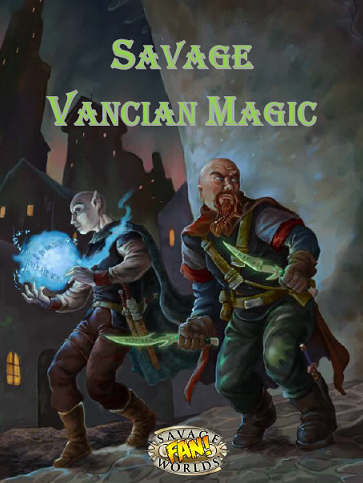
Savage Vancian Magic


Vancian magic (aka "fire and forget") seems to be one of those things that some people love and others hate. Although freeform magic is still probably my favorite approach in general, I was introduced to the Dragonlance novels at a young age, and Raistlin made a lasting impression on me.

More recently I've been interested in converting 3.x material to Savage Worlds, particularly the excellent War of the Burning Sky adventure path. I originally came up with a simple “Fast, Furious and Fun” solution for handling spellcasters (see the Arcane Backgrounds in Savage War of the Burning Sky), and used trappings to cover their spells (such as those in my Savage Spellbook supplement), but as the campaign progressed and the PCs advanced (and the wizard's player wanted to use the same sort of spells that had been available in our former D&D 3.5 campaign) my solution felt increasingly like trying to fit a square peg into a round hole. It just didn't capture the feel, the flavor, of the magic system. So after running a couple of dozens gaming sessions I went back to the drawing board and tried again, and this is the result.

It's perfectly possible to play a superhero game in Savage Worlds using just the core rules, but I find it much easier with the Super Powers Companion, which offers an alternative power system specifically geared towards supers settings. Savage Vancian Magic does exactly the same thing for D&D/Pathfinder settings. Neither the Super Powers Companion nor Savage Vancian Magic are required, but they are both designed to make the GM's job easier when running certain types of campaign.

You can download it from here: Savage Vancian Magic

The goal
"I love Savage Worlds. Half of the guys in my group love Savage Worlds. But part of what keeps the other half from jumping on board, at least for a fantasy campaign, is the lack of a Vancian magic system"
"But when it comes to fantasy, Vancian magic is hard coded into many gamers’ DNA. That’s certainly the case in my group – they like Savage Worlds well enough, but the lack of a Vancian magic system is a major stumbling block. They like being able to learn a large number of spells, and cherrypick from them each session. The Fantasy Companion doesn’t address that need, which is a shame since its addition could have won over some of the holdouts."
"SW is bad at settings with tons of weak magic spells. The average magic user in Savage Worlds has half a dozen quite powerful spells, most of them geared towards combat. If you want a game where the magic user has a lot of weak utility spells, and part of your fun is to find creative ways to use and exploit them, Savage Worlds is not the game for you."
The goal of Savage Vancian Magic is to capture the flavor of the 3.x magic system in a way that still feels like Savage Worlds. It is specifically aimed at people who want to play Savage Worlds, but also want 3.x–style spellcasters. Despite its name, this supplement covers both Vancian (i.e., “prepared”) and non–Vancian (i.e., “spontaneous”) spellcasters.

If you hate the 3.x magic system, you probably won't find Savage Vancian Magic useful – except perhaps as proof of concept, to demonstrate the versatility of Savage Worlds, and prove to the naysayers that even their sacred cow can be Savaged.

If you hate long spell lists then you definitely won't like this, but should instead take a look at my Savage Abilities supplement, which takes the opposite approach - it trims all the fat, reducing the power list to just five different powers. Those five powers can then be customised with modifiers and trappings to design a huge range of custom spell effects.

It should also be noted that this magic system differs from the magic in Jack Vance's work, as it’s inspired by the 3.x approach rather than Vance’s novels, however the commonly used term for both is still "Vancian magic".


Wednesday, 24 June 2015

The Thin Blue Line - A Detroit Police Story

The latest project by Melior Via (the company behind Accursed) is a modern urban fantasy setting, which focuses on the paranormal investigations of the psychically gifted police officers of Corktown Precinct.

John Dunn offered to let me have a sneak peek at the current draft of the player's guide, so I thought I'd give a quick overview in case anyone else was interested in the project. I will focus mainly on the crunch because that's the area I know best.

Chapter 1: Detroit History

The first chapter is 39 pages, around a quarter of which covers the history of Detroit, the rest describing the neighborhoods and regions of interest, along with some maps. Most of the information is based on real-world history and geography, but there are also subsections covering supernatural activity.

Someone who is already familiar with the history of Detroit might already know some of this information, but for anyone else the chapter is invaluable. It's also well organised, broken down into separate sections that each cover different parts of the setting.

Chapter 2: Corktown Precinct

This chapter is 11 pages, and focuses on Corktown Precinct and the police force. It delves more deeply into the supernatural side of things, describes the various ranks and roles of the police officers, and explains the recruitment and training process.

Chapter 3: Fresh Recruits

This chapter is 11 pages, and covers character creation, setting rules, Edges and Hindrances.

Everyone begins with Knowledge (Law) d6 for free, which feels a bit excessive to me - I'd expect a typical lawyer to have Knowledge (Law) d6, but for most police officers I would rely on Common Knowledge. Savage Worlds Deluxe actually uses a lawyer with Knowledge (Law) d4 in one of its examples, and none of the Police stats in the Horror Companion have Knowledge (Law) at all.

Characters are also required to take at least d4 in Driving, Fighting, Guts and Shooting, which seems pretty reasonable. However the fact that they're not freebies, and that Legal Authority is explicitly defined as an Edge rather than a setting rule, would imply to me that PCs don't need to be police officers if they don't want to be - a common trope in urban fantasy, where the supernaturally-gifted civilian protagonist is occasionally called upon for their expertise. I don't know whether that is the intent, but I think it would make a fun option, even if it's only included as a footnote.

Setting Rules

  • Just as Lucky: This rule was also used in Accursed, although I'm not overly fond of it for reasons I've outlined before.
  • Lost Illusions: Like "Damaged Characters" from Accursed.
  • Reason and Delirium: A new mechanic, somewhat reminiscent of the Roads/Paths in WoD. It's an interesting idea that fits the setting like a glove, and I think I prefer it to the sanity mechanics I've seen in other settings.
  • Skills: Like in Accursed, Guts is used for Fear checks, Climbing and Swimming are merged into Athletics, while Lockpicking and Stealth are merged into Subterfuge. Two new specific Knowledges (Forensics and Parapsychology) are also included, and they're a good fit for the setting.

As with Accursed, a few Edges and Hindrances are also included from the Horror Companion, although you could ignore them if you didn't want to purchase an extra book.

Hindrances

There are four new Hindrances. Disrupted Psyche is like Cursed from the Horror Companion, except it works against Psychic powers rather than Miracles, and has been reduced to a Minor Hindrance. Glass Jaw has shown up in other settings. The other two are more interesting (and unique as far as I'm aware): Gambler and Haunted.

Edges

There are two new Arcane Backgrounds and five new Edges (although one of those is Dirty Fighter, which has appeared in other settings). The Edges don't explicitly list their categories; Parapsychologist looks like a Professional Edge, but it would be nice to know for sure (because of the rules for stacking bonuses).

Chapter 4: Parapsychology

This chapter is 12 pages, and details the new Arcane Backgrounds and their powers, including 14 new powers geared towards different types of psychic characters. Most of the powers look pretty good, the only one I'd take exception to is Autodidact (+6 to any Knowledge skill of your choice with a duration in hours) - I'd personally reduce the bonus to +2 (the same as the Scholar Edge).

As well as Psychics, there are also rules for Nullifiers - characters who are able to block the supernatural powers of others. I wasn't too sure about treating them as an Arcane Background initially, but after reading the extensive flavour text I think it's a good fit.

The chapter finishes up with a few pages on paranormal phenomena and rival organisations.

Chapter 5: Gear Locker

This chapter is 10 pages, and covers equipment and vehicles. There's a lot of gear listed, some of it is the same as SWD and some of it is new. Most of it looks pretty good, although there are a few areas I'm hoping the writers will take another look at before publishing, in particular:
  • Tasers are described but don't have any stats yet. Hopefully they won't work the same as ETU (I explained here why I dislike their version).
  • Splinter Rounds give a +2 bonus to Shooting rolls (the same as shot) but it's not clear whether they inflict the same damage as shot (1-3d6 depending on range) or as slugs (2d10).
  • Cold Iron Rounds gain +2 AP against creatures vulnerable to cold iron, which seems a bit arbitrary; if a fae is vulnerable to cold iron, surely they would still benefit from wearing physical armour?
  • M84 Stun Grenade are described as being "used to blind and deafen enemies", but they don't actually cause either outcome, only Shaken. I would have expected them to work a bit like the Blind power with the Sound (Deafen) trapping from SWD.
  • Tear Gas Grenades also cause only Shaken, which (particularly considering the new Shaken rule) makes it a very weak option that will barely slow most foes down. The same with the Paranormal Irritant Spray. I would have thought Fatigue might be more appropriate.
  • Riot helmets are only 50% effective against head shots, the same as a pot helm - however unlike a pot helm, they have a polycarbonate visor. Helms with visors are usually 100% effective against head shots.
  • Motorcycle jackets provide the same protection as chainmail, which seems quite a lot. Even providing the same protection as leather armour would seem quite generous to me (I usually just treat them as reinforced clothing; +1 armour unless you're hit with a raise).
Summary

The version I looked at is still a draft, but it's packed full of good content and is clearly close to completion. It actually reminds me a bit of the novel "Rivers of London" (called "Midnight Riot" in the US) by Ben Aaronovitch, except based in Detroit rather than London, and I can definitely see it appealing to fans of urban fantasy.

You can check out the Kickstarter here, and view the website here. I will definitely be backing this one.

Wednesday, 17 June 2015

Converting D&D Armor and Shield Enchantments

In a previous post I discussed my ideas for converting magic weapons from D&D to Savage Worlds. This time I'm going to cover armor and shields.

The concept is pretty much the same, although one notable difference is that some of the magic bonuses for D&D armor and shields have a purely financial cost instead of a numeric bonus value. To keep things simple, I chose to stick to numeric bonuses (+1, +2, etc.). Some of the bonuses have also been merged (e.g., "Shadow" and "Silent Moves") or streamlined.

Standard Enchantments

Most magic armor and shields in D&D have a simple fixed bonus in the range +1 to +5, which is applied directly to the wearer's Armor Class. However Savage Worlds is far less granular, and even +1 armor is a potent bonus, so here is the approach I recommend.

+1 Armor: +1 armor, reduced to +0 if hit with a raise.
+2 Armor: +1 armor.
+3 Armor: +2 armor, reduced to +1 if hit with a raise.
+4 Armor: +2 armor.
+5 Armor: +3 armor, reduced to +2 if hit with a raise.

+1 Shield: +1 armor against ranged shots.
+2 Shield: +2 armor against ranged shots.
+3 Shield: +1 Parry.
+4 Shield: +1 Parry, and +1 armor against ranged shots that hit.
+5 Shield: +1 Parry, and +2 armor against ranged shots that hit.

This is also consistent with the ability prices listed in Savage Armoury. Note that if you're using Savage Armoury as well, enchanted weapons and armor should always have the Masterwork ability.

Special Enchantments

The following are some proposed conversions of the special armor and shield abilities used in D&D. As with the weapons, the goal is to retain the general flavor of the original ability, while significantly toning down the mechanical benefits to match those described earlier.

Acid Resistance (+1/+2): Acid damage against the wearer is reduced by 2 or 4 points.

Animated (+2): As a normal action you can release this shield from your hand, causing it to float beside you and protect you as if you were holding it. This is treated as if you were holding the shield for all purposes (including encumbrance and Arcane Spell Failure), except that you can use your hand for other things. You can grasp the shield again at any time as a free action, and cannot activate more than one Animated shield at a time.

Arrow Catching (+1): This shield can be activated as a normal action and deactivated as a free action. While active it attracts arrows, thrown weapons, and other ranged attacks, causing them to veer unerringly towards it. Any ranged attacks made against targets adjacent to you are automatically diverted towards you instead. All ranged attacks against you receive a +1 bonus to hit and halve any penalties for obscurement or poor lighting, but don't inflict any additional damage for Called Shots or raises, as they invariably strike the center of your shield. This ability does not work against spells or area-effect attacks, nor against particularly large attacks such as siege weapons.

Arrow Deflection (+2): This shield can be used once per round to try and deflect a ranged attack that would normally hit you, as long as you are aware of it and not Shaken; make an opposed Agility roll against the attack roll, if you win then the attack is deflected and misses you. This ability does not work against spells or area-effect attacks, nor against particularly large attacks such as siege weapons.

Bashing (+1): This shield inflicts +1 damage when used to make a Shield Bash maneuver.

Blinding (+1): This shield can unleash a flash of brilliant light up to twice per day as a normal action, filling an area the size of a Large Burst Template centered on the character. Everyone within the area (other than the character) must make a standard (TN 4) Agility roll or become Shaken; if a target rolls 1 on their Agility die (or rolls a critical failure if they're a Wild Card) they are also blinded until they recover from being Shaken.

Cold Resistance (+1/+2): Cold damage against the wearer is reduced by 2 or 4 points.

Electricity Resistance (+1/+2): Electricity damage against the wearer is reduced by 2 or 4 points.

Etherealness (+3): This armor allows the wearer to cast Intangibility on themselves, using Spirit for the arcane skill roll; the armor has 5 Power Points for this power.

Fire Resistance (+1/+2): Fire damage against the wearer is reduced by 2 or 4 points.

Fortification (+1/+2): This armor or shield produces a magical force which protects the vitals. Additional damage caused by Called Shots is reduced by 2 or 4.

Ghost Touch (+3): This armor or shield protects against both ethereal and non-ethereal creatures. It can also be picked up and used by ethereal creatures.

Glamoured (+1): This armor can take on the illusionary appearance of a normal set of clothing, although it still retains its normal weight and provides its normal protection. The illusionary appearance is always the same, but remains active as long as the wearer wishes; switching the illusion on or off is a normal action.

Invulnerability (+3): This armor increases the wearer's Vigor by +1 die step.

Reflecting (+5): This shield can be used once per day to reflect a spell that targets you personally (i.e., it doesn't work against area effect spells). Make a standard (TN 4) Spirit roll, with a -2 penalty if the spell was cast with a raise: on a failure you are affected by the spell, while on a success the spell is reflected back on the caster.

Shadowy (+1/+2): This armor grants you a +1 or +2 bonus to Stealth rolls when attempting to move silently or remain unseen.

Slick (+1): This armor grants you a +2 bonus to resist and escape from grapple, constrict, Entangle, and other forms of confinement.

Sonic Resistance (+1/+2): Sonic damage against the wearer is reduced by 2 or 4 points.

Spell Resistance (+2/+4): This armor grants the wearer a +1 or +2 bonus to resist opposed magic, as well as +1 or +2 armor against damage-causing magic.

Undead Controlling (+3): This armor or shield grants the wearer the ability to cast Puppet on any creature with the Undead ability, using Spirit for the arcane skill roll; the armor has 5 Power Points for this power.

Wild (+3): This armor or shield continues to provides its armor and Parry bonuses to the wearer while they are shapechanged into the form of an animal.

Tuesday, 9 June 2015

Monster Builder

A couple of weeks ago someone on Google+ asked if there were any resources for simple monster creation - a sort of "dummies guide". I thought that sounded like a good idea, as I often see people making mistakes when writing up monsters (particularly with Parry and Toughness), so I put together a tool for it. 

You can access it here: Monster Builder

It's designed to be quick and easy to use, so it doesn't offer the same amount of detail as some of my other tools, but it might be helpful for people who don't yet have much experience with building monsters.